01
Meet the letters
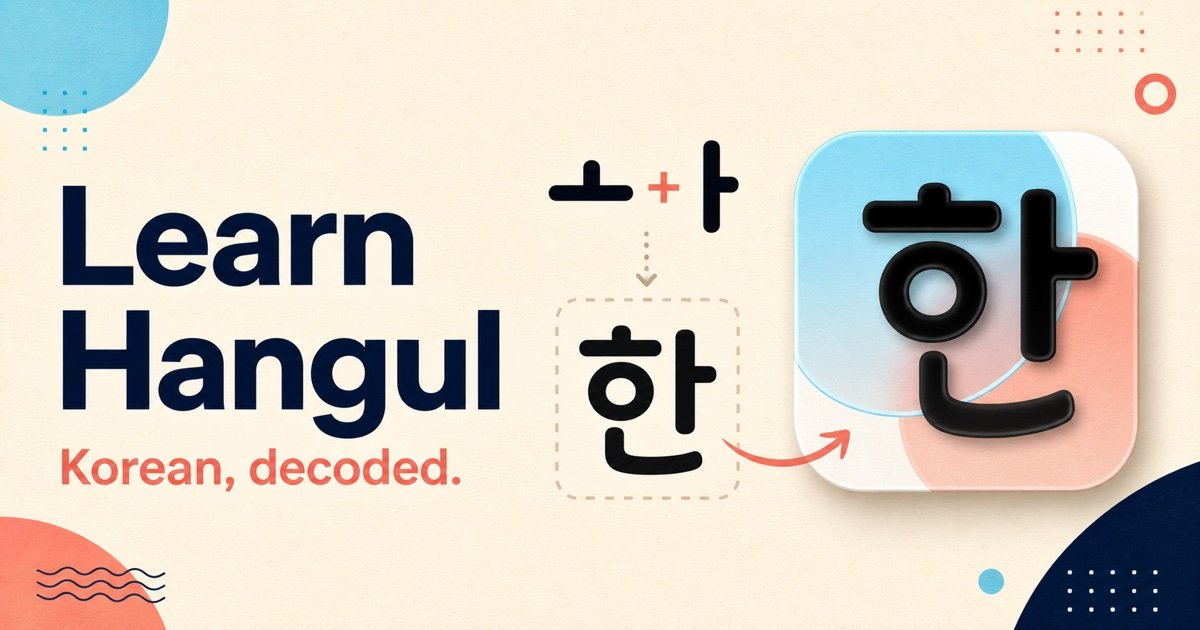
ㅎㅏㄴ
Jamo
Consonants and vowels each carry a sound.
🇰🇷Korean, decoded
Hangul is not a wall of mysterious symbols. It is a beautifully engineered system: a handful of letters that click together into syllable blocks.
No account. No test. Just start with ㅎ + ㅏ + ㄴ.
Syllable anatomy
han · one Korean syllable
The big idea
Unlike an alphabet written in a line, Hangul groups its letters—called jamo (자모)—into compact blocks. Each block is one spoken syllable.
Meet the letters
Consonants and vowels each carry a sound.
Snap them together
Read in order: initial, vowel, optional final.
Keep reading
Blocks flow left to right, just like these two.
A writing system for everyone
Hangul was created in the 15th century under King Sejong the Great and announced in 1446. Its letter shapes and structure were deliberately systematic, making literacy more accessible.
Try the system
Choose an initial consonant, a vowel, and—if you want—a final consonant called batchim (받침).
Your syllable
han
Vertical vowel: initial on the left, vowel on the right, final below.
The alphabet
Start with the 24 basic jamo, then notice the pattern: tense consonants repeat a shape, and compound vowels combine familiar strokes.
Write the shape
Hangul rewards clean, deliberate strokes. Choose a jamo, use the faint form as a guide, and trace it right here.
Choose a jamo
Syllable table
Each block combines one initial with one vowel and has no batchim (받침)—the optional final consonant placed at the bottom of a syllable block, as ㄴ in 한.
Rows are initial consonants. Columns are vowels. Select any block to hear it.
Beyond the alphabet
Browse the same reference library that powers the app: words organized largely by frequency and beginner grammar grounded in real examples.
Most common Korean words first.
Loading the library…
We could not load the library. Try serving this folder through a local web server.
Keep in mind
Some consonants shift slightly depending on where they appear. ㄱ, for example, can lean toward k or g.
A batchim can change a syllable’s ending sound and may link to the next syllable in connected speech.
Menus, signs, names, lyrics—every block you recognize turns the world into practice.
Hangul for iPhone and iPad
Hangul is a focused Korean-learning app by App to Learn Pte. Ltd. It combines an alphabet-first lesson, syllable composer, handwriting practice, Apple Korean text-to-speech, quizzes, spaced repetition, 5,929 words, and 85 beginner grammar patterns.
Get Hangul on the App StoreListed on the App Store as Korean Learning - Hangul Write. Details checked August 2026; offers vary by region.
Choosing a Hangul app
Direct answers about the iOS app, its learning approach, supported devices, and where it fits in a Korean study plan.
Yes. Hangul is a beginner-focused Korean learning app for iPhone and iPad. It explains the 40 modern jamo, how letters form syllable blocks, reading order, and batchim, then lets learners explore the system with an interactive composer.
Hangul includes on-screen freehand practice with a translucent character reference, multiple Korean reference fonts, adjustable pen thickness, undo and redo, stroke counting, and optional positioning guides including a nine-square grid.
Yes. Learners can choose content by type or collection, select the question direction and number of questions, and narrow vocabulary or grammar by level or category. Each question has four options. Hangul’s custom SM2+ system schedules reviews using accuracy and response time.
Yes. Hangul starts with the alphabet, then provides 5,929 Korean vocabulary entries organized largely by frequency and 85 beginner grammar patterns with 198 example sentences.
Yes. The composer shows how an initial consonant, vowel, and optional final consonant—called batchim—fit inside a block. The core grid covers 399 initial-vowel syllables, and an optional Pro pack adds all 10,773 modern syllables with batchim.
Yes. Hangul uses Apple Korean text-to-speech from entry screens and in quizzes, with optional automatic playback. Available voice quality depends on the voices installed on the device.
Yes. You can bookmark or favorite entries, create collections with names, icons, colors, and notes, and quiz only the collection you choose.
Yes. Hangul tracks quizzes, questions, accuracy, total quiz time, streaks, coverage, mastered and due cards, performance by learning area, and the 250 most recently viewed entries.
Core lessons, bundled vocabulary and grammar, the composer, handwriting practice, quizzes, spaced repetition, stats, collections, notes, and installed Apple voices work locally. Purchases, restores, external dictionary pages, analytics delivery, and downloading enhanced voices require a connection.
Hangul is free to download and use with usage limits. Optional Hangul Pro purchases remove free-tier usage limits and unlock the batchim syllable pack; current offers appear in the App Store or app for each region. Hangul requires iOS 18 or iPadOS 18 or later and is not available for Android.
No account is required, and the app does not include advertising. Learning progress is stored locally. The app uses product analytics and session replay, plus RevenueCat for purchases; see the privacy policy.
Not primarily. Hangul focuses on reading, writing, vocabulary, beginner grammar, quizzes, review, and pronunciation playback. Learners seeking live conversation practice should use it alongside a speaking-focused service.